Value Payable Post (VPP) Explained (2026)
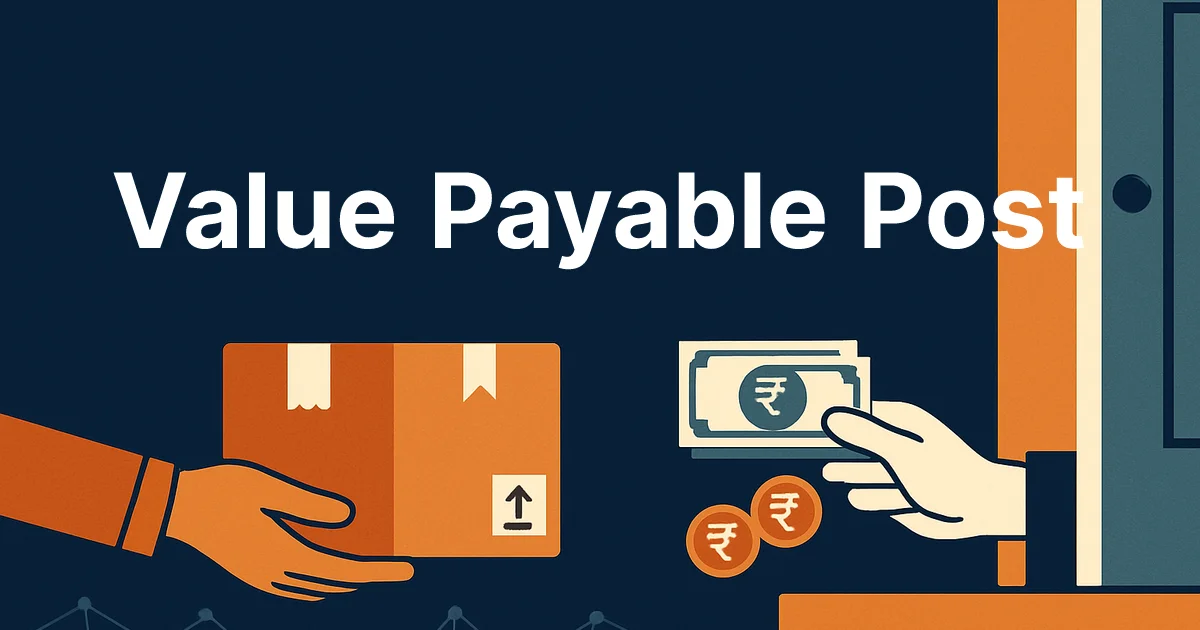
Before private couriers made cash on delivery a household phrase, India Post had been doing the same thing for over a century. A seller could post goods, and the postman would hand them over only after collecting payment, then send the money back. That service is Value Payable Post, or VPP, and it still operates across the country's network of 164,999 post offices in 2026.
VPP is India Post's terminology for cash on delivery (COD). The recipient pays for an article at the moment of delivery, and the post office remits the collected amount to the sender. It let businesses reach buyers in towns where advance payment was impractical, long before digital wallets existed.
This guide explains how Value Payable Post works in 2026, what it costs, the maximum value it can carry, and why it still has a place even as platform-led COD dominates online retail. It also sets out the steps for a sender and how delivery and remittance are completed.
What Value Payable Post is
Value Payable Post is a postal service in which India Post delivers an article to the recipient only after collecting the amount due, then remits that amount to the sender. The value to be remitted to the sender for any single VPP article cannot exceed ₹5,000, which keeps the service aimed at small-value goods.
The sender declares the amount to be collected, packs the goods, and books them as a VPP article. The delivery office collects the declared sum plus the VPP charge from the recipient before handing over the item, then transfers the declared amount to the sender, usually by money order or credit.
"The amount specified for remittance to the sender in the case of any value payable postal article shall not exceed ₹5,000." (India Post, 2026.)
VPP is effectively the postal ancestor of modern COD, designed so a buyer who cannot or will not pay in advance can still receive goods, while the seller is protected because the item is released only against payment.
VPP and India's cash-on-delivery culture
Cash on delivery remains a dominant payment method in Indian e-commerce, and VPP is the postal expression of that long-standing preference for paying only when goods arrive. The model exists because buyer trust in distant sellers has historically been low, and paying at delivery removes the risk of paying for nothing.
For a buyer in a smaller town, VPP offers the same reassurance a modern COD order does: the cash leaves their hand only when the parcel is in it. This is why the service predates and parallels the COD systems that online marketplaces later built.
The persistence of cash in India, even alongside rapid UPI growth, means a payment-on-delivery option still has real demand. VPP serves the segment that buys directly from a seller rather than through a platform that offers its own COD.
How Value Payable Post works
VPP works in three stages: booking by the sender, collection at delivery, and remittance back to the sender. The single defining rule is that the postman releases the article only after the recipient pays the full amount.
Booking the article
The sender packs the goods, completes a VPP form declaring the amount to be collected, and books the article at a post office. The declared value cannot exceed ₹5,000, and the sender pays the postage and VPP fee at booking.
Collection and remittance
At the delivery end, the postman collects the declared amount plus the VPP charge from the recipient before handing over the article. The post office then remits the declared sum to the sender, completing the transaction so the seller receives payment without having required it in advance.
Value Payable Post charges in 2026
The VPP charge is collected from the recipient in addition to the declared value of the goods, and is commonly cited at around 5% of the declared amount. So if the declared value is ₹500, the recipient pays ₹525, the extra ₹25 being the VPP charge.
On top of this, the sender pays the normal postage for the article, whether sent as a parcel or registered article, at booking. Rates are set by the Department of Posts and revised periodically, so a sender should confirm the current VPP commission and postage at the counter.
| Cost element | Paid by | Basis |
|---|---|---|
| Declared value of goods | Recipient | Set by sender, up to ₹5,000 |
| VPP commission | Recipient | Around 5% of declared value |
| Postage / parcel charge | Sender | Weight and service based |
The arithmetic means a recipient always pays slightly more than the declared price, and the seller receives the declared value while bearing the outbound postage. For small consignments, this keeps the cost predictable for both sides.
How VPP fits a small seller's workflow
For a small direct seller, VPP turns the post office into a built-in payment-collection agent, removing the need for a payment gateway or marketplace account. The seller packs goods, books them as VPP with a declared value, and lets India Post collect and remit the money.
This suits sellers of books, magazines, handicrafts, and documents who deal directly with customers rather than through a platform. It is especially useful where the buyer is in a small town that private courier COD does not serve, since India Post reaches every PIN code.
The trade-off is that the ₹5,000 remittance cap and the outbound postage make VPP best for low-value, low-volume selling. A high-volume e-commerce seller is usually better served by a marketplace's integrated COD and reconciliation.
Who still uses VPP
VPP remains useful for sellers reaching buyers in areas where platform COD or card payment is not available, and for dispatching documents, books, and small goods against payment. It is still used by publishers, philatelic sellers, and small traders who post directly rather than through e-commerce marketplaces.
For larger or trackable shipments, many businesses now prefer India Post parcel services or private courier COD, and the choice depends on value and volume. Sellers comparing options can review the weight limits and charges in the India Post parcel guide before deciding.
"Value Payable Post is used to recover the price of goods supplied along with postal charges from the addressee at the time of delivery, and to remit the amount to the sender." (Maharashtra Postal Circle, India Post, 2026.)
Risks and refusals a sender should plan for
The main risk in VPP is that the recipient refuses to pay or accept the article at delivery, in which case the goods are returned to the sender. The sender still bears the outbound postage, so a refusal means a small loss even though the goods come back.
Because of this, VPP works best when there is a genuine prior agreement to buy, rather than for unsolicited dispatch. Sending unrequested goods by VPP is poor practice and often leads to refusal at the door.
Senders should also pack goods securely and declare an accurate value, since the declared amount is what the recipient pays and what is remitted back. A mismatch between the order and the declared value is a common cause of disputes and refusals.
What happens to a refused or undelivered VPP
If the recipient refuses the article or is unavailable after repeated attempts, the VPP is returned to the sender rather than abandoned. The goods come back, but the sender has still paid the outbound postage, so a refusal carries a small cost.
A sender can follow the article's status using its consignment number to see whether it is out for delivery, held, or being returned. Acting early, by confirming the buyer still wants the order, can prevent a return before the article travels all the way back.
Where a VPP is genuinely lost or the remittance does not reach the sender, the issue can be raised as a complaint with India Post using the consignment number. Keeping the booking receipt is therefore essential, since it carries the reference needed to trace both the article and the money.
Practical tips for a first-time VPP sender
A first-time VPP sender should confirm the order and price with the buyer in writing before booking, so the amount collected matches what was agreed. This single step prevents most refusals, which are the biggest cause of loss in VPP.
Packing the article securely and entering the correct PIN code keeps the consignment on route to the right delivery office. Senders unsure of the destination code can confirm it through the PIN code finder before booking.
Keeping the booking receipt and consignment number lets the sender follow the article and the remittance until both are complete. For repeat selling, a sender should track refusal rates and adjust which buyers are offered VPP.
VPP versus modern cash on delivery
VPP and platform COD share the same idea but differ in scale, with VPP capped at a ₹5,000 remittance while e-commerce COD often handles higher values. The postal route suits direct sellers, while platform COD suits marketplace sellers who want integrated returns and reconciliation.
The remittance to the sender under VPP is typically routed through the postal money order system, which links it to the wider India Post money order framework. A sender can also follow a VPP article through the network in the same way as any registered item, using the method in the India Post tracking guide.
| Feature | Value Payable Post | E-commerce COD |
|---|---|---|
| Maximum remittance to sender | ₹5,000 | Often higher, platform-dependent |
| Best for | Direct sellers, documents, books | Marketplace orders |
| Payment release | Goods handed over only on payment | Goods handed over only on payment |
| Remittance route | Postal money order or credit | Platform settlement to seller |
Looking ahead
VPP will keep serving the long tail of direct postal selling even as marketplace COD dominates the roughly US$160 billion Indian e-commerce market. Its value lies in giving any individual or small business a payment-on-delivery option without joining a platform, using a network that reaches every PIN code.
For a sender, the essentials are unchanged: declare a value within the ₹5,000 ceiling, pack the goods properly, and book the article correctly so the postman collects before delivery. Done right, VPP still closes the trust gap between a distant buyer and seller exactly as it has for generations.
Key takeaways
- Value Payable Post (VPP) is India Post's cash-on-delivery service, where goods are released only after the recipient pays.
- The amount remitted to the sender for a single VPP article cannot exceed ₹5,000.
- The recipient pays the declared value plus a VPP commission commonly cited at around 5%, while the sender pays the postage.
- VPP still suits direct sellers, publishers, and document senders who post outside e-commerce platforms.
- A refusal at the door returns the goods to the sender, so VPP works best with a genuine prior agreement to buy.
Methodology
This guide is based on India Post and state postal circle documentation describing the Value Payable Post service, with charge and limit figures reflecting publicly available postal references as of June 2026. VPP commission, postage, and the value ceiling are set by the Department of Posts and revised periodically, so a sender should confirm the current rates at a post office before booking. This article is general information about a postal service and is not financial advice.