India Post Money Order 2026: Charges, Limits & How to Send
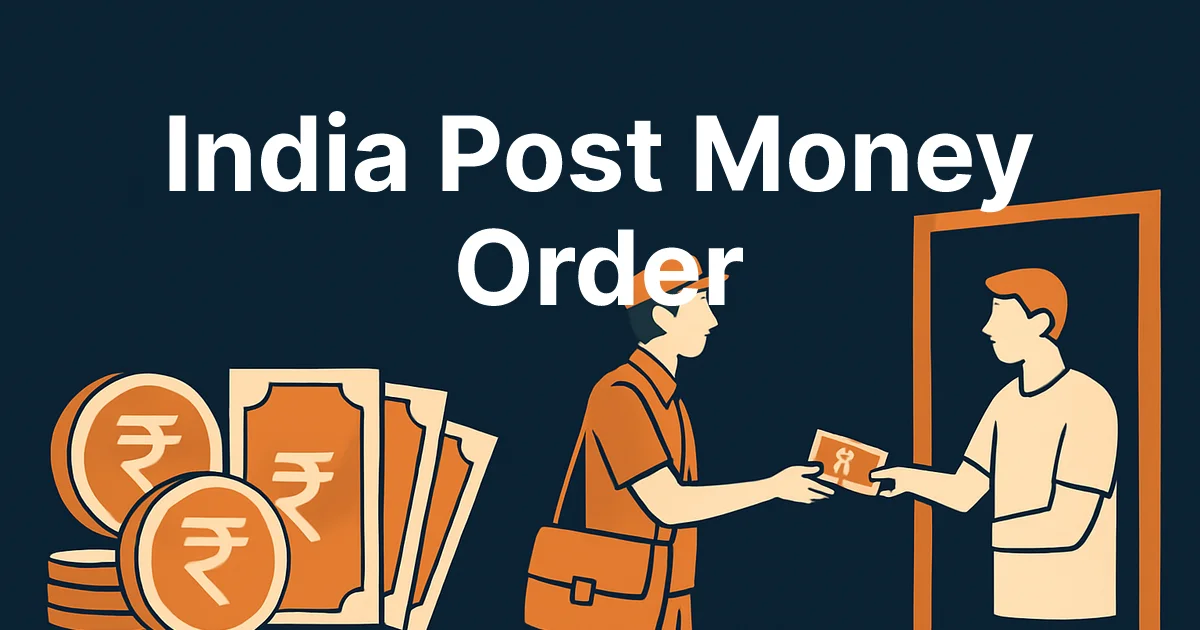
Long before mobile wallets, the postman who counted out cash at the door was the most trusted way to send money across India. That service, the India Post money order, still operates in 2026, carrying funds to villages and addresses that formal banking has yet to reach fully. For a remitter who knows only an address and a name, it remains one of the few ways to deliver cash to a doorstep nationwide.
A money order is a remittance sent through the post office, where the sender pays cash at one counter and India Post delivers the same amount to the payee at another address. The department has modernised the service into an electronic form, but the core promise is unchanged: money handed in at one office reaches a named person elsewhere, in cash, with a paper acknowledgement.
This guide explains how an India Post money order works in 2026, what it costs, the maximum that can be sent, and where faster options now make more sense. It also sets out the documents needed and how delivery is confirmed.
What an India Post money order is
An India Post money order is a service that transfers a fixed sum of cash from a sender to a named payee through the postal network, with the amount delivered to the payee's address. The maximum that can be remitted through a single money order is ₹5,000, a ceiling that has shaped how the service is used for small, regular transfers.
The sender completes a money order form, pays the amount plus commission in cash, and receives a receipt with a unique number. India Post then routes the remittance to the delivery office nearest the payee, where the postman pays the cash and obtains a signature or thumb impression as proof.
"Electronic Money Order (eMO) is a web based money remittance service offered by the Department of Posts, where the amount is delivered to the recipient's doorstep by the postman." (India Post, 2026.)
The acknowledgement is a defining feature: the sender receives confirmation once the payee has been paid, which is why the service has endured for generations of pension, family, and small-trade payments.
A brief history of the money order in India
The postal money order has served India for more than a century, introduced under British administration in 1880 as a safe way to move small sums without physical currency travelling by post. For most of the twentieth century it was the primary remittance channel for migrant workers sending earnings home.
Generations of families relied on the monthly money order from a son in a city to parents in a village, and the service became woven into rural economic life. Its cultural weight is why India Post retained and digitised the service rather than retiring it as banking spread.
The shift to the Electronic Money Order in recent years modernised the back-end while preserving the doorstep cash payout that defined the original. The result is a service that is simultaneously one of India's oldest and, through eMO, one of its faster postal remittance options.
Why the money order still matters in 2026
The money order survives because India Post reaches places banks do not, operating 164,999 post offices of which roughly 90% are rural. For a recipient in a village with no nearby bank branch, a cash delivery to the door remains genuinely useful.
India still runs heavily on cash for small everyday transactions despite the rise of UPI, and the money order serves people who are not comfortable with, or do not have access to, digital banking. The postman acting as a paying agent extends the financial network to the last village.
The service is also valued for its paper trail, since the acknowledgement gives the sender documented proof that the payee received the money. This makes it useful for small formal payments where a record matters more than speed.
Types of money order in 2026
India Post offers more than one form of money order, and the electronic version has largely replaced the slow paper route. Each type differs in speed and how the remittance is processed, though all cap a single transaction at ₹5,000.
Ordinary Money Order (OMO)
The Ordinary Money Order is the traditional paper-based service in which the form physically travels through the postal network before delivery. It is the slowest option, often taking several days, and survives mainly where electronic processing is not used.
Electronic Money Order (eMO)
The Electronic Money Order transmits the remittance details electronically between offices, so booking and onward processing happen the same day at the sending office. Money booked through eMO is typically disbursed within 24 hours, making it far faster than the paper form while keeping doorstep cash delivery. The mechanics of tracking and booking an eMO are covered in the dedicated Electronic Money Order guide.
India Post money order charges in 2026
India Post levies a commission on every money order, and the service fee is not subject to GST. Charges are revised periodically, so a remitter should confirm the current slab at the counter, but the structure has stayed close to a small fixed fee scaled by amount.
For lower-value transfers, commonly cited slabs place the fee at ₹5 for amounts up to ₹200, ₹10 for ₹201 to ₹1,000, and ₹15 for ₹1,001 to ₹5,000. Some offices apply a flat eMO commission of around ₹25 for amounts up to ₹1,500 and ₹35 for ₹1,501 to ₹5,000, so the exact figure depends on the service type and current tariff.
| Amount remitted | Typical money order commission |
|---|---|
| Up to ₹200 | ₹5 |
| ₹201 to ₹1,000 | ₹10 |
| ₹1,001 to ₹5,000 | ₹15 |
| eMO (flat, up to ₹1,500) | Around ₹25 |
| eMO (flat, ₹1,501 to ₹5,000) | Around ₹35 |
No GST is charged on money order commission, so the fee shown at the counter is the full cost. The payee receives the entire remitted amount, with the commission paid separately by the sender.
A worked example
If a sender remits ₹4,000 to a relative, the payee receives the full ₹4,000 in cash at their door, and the sender pays only the small commission on top at booking. The commission does not come out of the ₹4,000, which is why a money order is predictable for the recipient.
How to send an India Post money order
Sending a money order takes a single visit to a post office and about ten minutes at the counter. The process is deliberately simple so that it works for senders without a bank account.
Step by step
The sender first collects and fills the money order form with the payee's full name, complete address, and correct six-digit PIN code, since an accurate code routes the cash to the right delivery office. A wrong code can delay delivery, which is why confirming it through the PIN code finder before posting is worthwhile.
The sender then hands the form and the cash, plus commission, to the counter clerk and receives a stamped receipt carrying a unique money order number. This number is used to follow the remittance until the acknowledgement returns confirming payment to the payee.
Documents required
For most money orders up to ₹5,000, the sender provides a valid identity proof such as Aadhaar at the counter, and no bank account is needed. The payee simply signs or provides a thumb impression at delivery to receive the cash, which keeps the service accessible to the unbanked.
If the payee is not available
If the postman cannot find the payee on the first attempt, the money order is taken back to the office and delivery is reattempted, so a single missed visit does not cancel the remittance. If it remains undelivered after repeated attempts, the amount is returned to the sender, which is one reason the acknowledgement system matters.
How money orders compare with modern alternatives
The ₹5,000 ceiling and counter visit mean money orders now compete with instant digital transfers that move far larger sums in seconds. For many users, India Post Payments Bank and UPI have become the default, while money orders hold a niche for cash delivery to addresses rather than accounts.
India Post Payments Bank (IPPB) offers doorstep banking and domestic money transfer with higher limits and digital tracking, and opening an IPPB account gives access to instant transfers that a traditional money order cannot match. The choice comes down to whether the recipient needs cash at a doorstep or funds in an account.
| Feature | India Post Money Order | IPPB / UPI transfer |
|---|---|---|
| Maximum per transaction | ₹5,000 | ₹1 lakh or more (UPI), higher for bank transfer |
| Delivery | Cash to payee's address | Credit to bank account or wallet |
| Speed | Same day to a few days | Seconds |
| Recipient needs a bank account | No | Yes |
| Acknowledgement | Paper acknowledgement to sender | Instant digital confirmation |
"A minimum of ₹1 and a maximum of ₹5,000 can be sent through Electronic Money Order, and the amount can be disbursed within 24 hours." (National Portal of India, 2026.)
When to choose a money order
A money order is the right tool when the recipient needs physical cash and has no convenient bank account or digital wallet. It suits sending small sums to elderly relatives, rural family members, or anyone who transacts only in cash.
For amounts above ₹5,000, or where the recipient has a bank account, a digital transfer through IPPB or UPI is faster and has no ceiling at the money order's level. Matching the method to the recipient's situation is the simplest way to avoid both delay and unnecessary cost.
Money orders also remain common for small institutional payments, such as application fees, subscriptions, and remittances tied to a documented acknowledgement. In those cases the proof of payment, not the speed, is the deciding factor.
Limitations to keep in mind
The ₹5,000 ceiling is the single biggest limitation, since anyone needing to send more must split the amount across multiple money orders or use a bank channel instead. For larger remittances, this makes the money order impractical compared with a single digital transfer.
Delivery also depends on the postman reaching the payee in person, so a wrong address, a missing house number, or an unavailable recipient can delay or return the remittance. Senders reduce this risk by providing a complete address and, where possible, a contact number for the payee.
Finally, the money order is a domestic service, so it cannot be used to send money abroad. Cross-border remittances require a bank or an authorised money-transfer operator, since the postal money order operates only within India.
Looking ahead
The money order will keep narrowing toward its core role of delivering cash where accounts do not reach, as India Post pushes IPPB and digital remittance for everything else. The ₹5,000 cap and the rise of UPI mean the service is now a complement to banking, not a rival to it.
For senders who need cash placed in a named person's hand at a verified address, the India Post money order still does something no app fully replicates. Confirming the current commission at the counter and entering the correct PIN code remain the two steps that keep a remittance on time.
Key takeaways
- An India Post money order sends up to ₹5,000 in cash from a sender to a payee's doorstep, with a paper acknowledgement on delivery.
- Commission is a small fee scaled by amount, often ₹5 to ₹15 for lower values or a flat eMO charge near ₹25 to ₹35, and no GST applies.
- The Electronic Money Order (eMO) is disbursed within 24 hours, far faster than the paper Ordinary Money Order.
- The payee needs no bank account, which keeps money orders useful for the roughly 90% of India Post offices that are rural.
- For larger or instant transfers, IPPB and UPI now offer higher limits and second-by-second confirmation.
Methodology
This guide is based on India Post and National Portal of India documentation for the money order and Electronic Money Order services, supported by current rate slabs reported by postal service references as of June 2026. Money order commission and limits are set by the Department of Posts and revised periodically, so figures should be confirmed at a post office counter before sending. This article is general information about a postal service and is not financial advice.