India's E-commerce Market 2026: Growth Analysis, Key Trends & Business Strategies to 2030
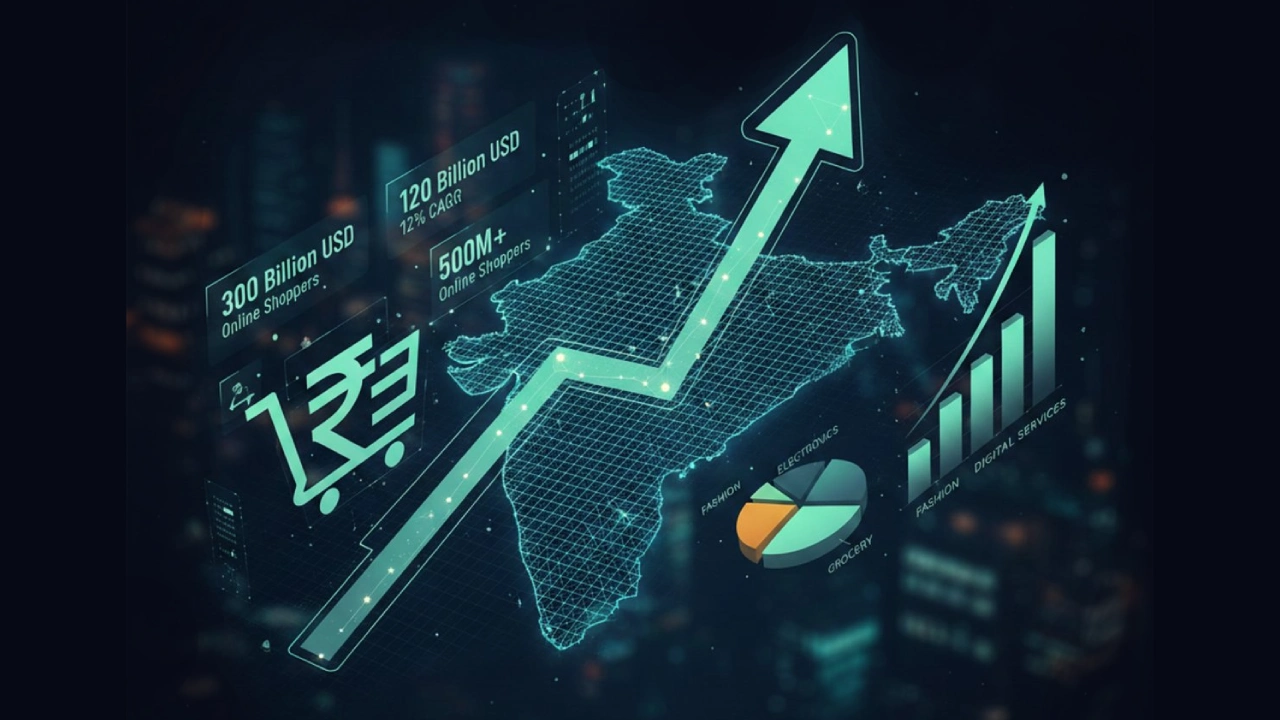
India's e-commerce market has moved from a metro-city convenience to a nationwide shift in how more than a billion people shop. What was once concentrated in a few large cities now reaches deep into smaller towns, reshaping retail across the country.
The scale is substantial and the trajectory steep. India's e-retail market crossed roughly US$60 billion in gross merchandise value in 2024 and is projected to reach US$170–190 billion by 2030, growing at over 18% a year, according to Bain & Company.
This article analyses where that growth is coming from, the consumer behaviour driving it, the business models reshaping the market, and the strategies that fit India's next five years of online retail. The picture that emerges is of a young, fast-moving market whose centre of gravity has shifted decisively beyond the metros.
How big is India's e-commerce market?
India is now one of the largest online retail markets in the world by shopper count, with more than 270 million people shopping online in 2024. That base, on Bain's figures, puts India second only to China by number of online shoppers.
"India's e-retail market is expected to scale to US$170–190 billion by 2030, growing at over 18% annually." (Bain & Company, How India Shops Online 2025.)
The headline number depends on definition. Bain measures e-retail GMV at about US$60 billion in 2024, while broader e-commerce estimates that include travel and services run higher, but both point to strong double-digit growth toward the end of the decade.
The market is growing despite economic headwinds
E-commerce kept expanding even as broader consumption slowed, growing 10–12% in 2024. Private consumption growth fell from about 11% before the pandemic to around 8% between 2022 and 2024, yet online retail outpaced it — a sign of how embedded online shopping has become.
Several tailwinds are lining up for faster growth from 2025. Rising disposable income, lower borrowing costs, and India's GDP per capita crossing the US$3,500–4,000 threshold — a level globally linked to higher discretionary spending — all support the forecast 18%+ growth rate.
Geography reinforces the trend. States that have already crossed that income threshold, such as Maharashtra, Karnataka, Tamil Nadu, and Gujarat, show about 1.2 times higher e-commerce penetration than others, so the market widens as more states reach it.
Online will be about one in ten retail purchases by 2030
E-commerce is set to roughly double its share of Indian retail by 2030. It currently accounts for about 6% of all retail sales, a figure expected to reach 9–11% by 2030 — meaning roughly one in ten rupees of retail spending will flow through digital channels.
That growth velocity outpaces peers such as Brazil and Indonesia, placing India among the fastest-growing major e-commerce markets. The penetration gap with developed markets, where online is 15–20% of retail, is what leaves so much room to expand.
Small towns are driving the growth story
The fastest growth in Indian e-commerce now comes from outside the metros. More than 125 million new online shoppers have emerged in recent years, the majority from tier-2, tier-3, and tier-4 cities, according to research from PwC.
The shift shows up across the funnel. During the 2023 festive season, about 80% of e-commerce sales came from non-metro regions, and roughly 60% of new sellers since 2021 have come from smaller cities — people in these places are selling, not just buying.
"Over 125 million new online shoppers have emerged in recent years, with the majority coming from smaller cities." (PwC India, e-commerce research.)
This reframes the market entirely. E-commerce is no longer a metro phenomenon with rural spillover, but a national market whose centre of gravity is steadily moving toward smaller cities and towns.
The drivers are practical: limited local product availability, price consciousness, trust in online reviews, social-media product discovery, and an aspiration to access the same brands as big cities. Together they make small towns the engine of the market rather than an afterthought.
What Indian shoppers actually want
Shopper priorities differ sharply by geography. Urban buyers rank quick delivery highly, with about 50% citing it as important, alongside convenience and product variety.
Outside the metros, value leads: around 54% of non-metro shoppers cite the best deals and price transparency as decisive, and roughly 60% prefer shopping through apps rather than mobile websites. Trust-building remains crucial, with many tier-2 and tier-3 buyers, especially Gen Z, still favouring cash on delivery, while YouTube dominates product research nationwide.
Women are an increasingly independent force in this market, shopping online in their own right as incomes rise. For brands, the takeaway is that a single national playbook rarely works; the messaging, payment options, and delivery promises that win in a metro often differ from what builds trust in a smaller town.
Three business models reshaping e-commerce
Bain identifies three distinct models transforming Indian online retail, each serving a different need. The table below summarises how they compare.
Model | What it is | Scale & growth | Examples |
|---|---|---|---|
Quick commerce | Delivery in under 30 minutes | ~10% of e-retail GMV; 40%+ annual growth | Grocery-led, expanding to electronics, beauty |
Trend-first commerce | Fast, low-cost fashion and beauty | Projected US$8–10 billion by 2028 | Zudio, Snitch, Urbanic, Myntra FWD |
Hyper-value commerce | Ultra-low prices, mostly under ₹500 | ~12–15% of e-retail value | Meesho, Shopsy, Amazon Bazaar |
Quick commerce
Quick commerce has moved from experiment to mainstream, now accounting for about 10% of e-retail GMV and growing over 40% a year. It serves more than 20 million shoppers and handles 70–75% of e-grocery orders, with the top six metros driving roughly 85% of value as it expands to 70-plus cities.
Trend-first commerce
Trend-first commerce targets hyper-trendy, low-cost fashion and beauty, and is projected to grow about four times to US$8–10 billion by 2028. It runs on Gen Z's social-media culture, frequent style drops, and an influencer ecosystem growing around 20% a year on Instagram alone.
Hyper-value commerce
Hyper-value commerce sells ultra-low-priced products, mostly under ₹500, and now represents 12–15% of e-retail value. It is where India's small sellers scale fastest, mirroring the global rise of low-price models that reached tens of millions of users abroad.
What Indians buy and how they pay
High-frequency categories dominate spending and will account for 65–70% of all e-commerce spend by 2030. Grocery, lifestyle, and general merchandise lead, while beauty and personal care grows about 30% a year and trend-first fashion 50–55% a year through 2028.
Payments have consolidated around UPI, which now carries the majority of transactions, per Payments and Commerce Market Intelligence. The breakdown below shows the current mix.
Payment method | Share of transactions |
|---|---|
UPI | 55% |
Credit cards | 25% |
Digital wallets | 7% |
Cash on delivery | 5% |
Buy now, pay later | 3.2% |
Debit cards | 2% |
UPI's dominance reflects India's distinctive digital-payment infrastructure. The persistence of cash on delivery, though small, underlines how much trust still matters in newer markets.
The cross-border opportunity
About 10% of India's e-commerce purchases are cross-border, pointing to demand local supply does not fully meet. Indian shoppers buy most often from the United States (21%), Australia (14%), and China (11%).
The motivations are quality and access: roughly 40% cite higher quality, 33% point to products unavailable locally, and 31% are drawn by discovering new items. For international brands, that is a clear entry point in categories where local availability is thin.
Big players are doubling down
Investment scale signals where large companies see the opportunity. Amazon announced a US$35 billion India investment plan through 2030, on top of roughly US$40 billion already invested, as covered in IndiaPost's report.
The company says it has digitised over 12 million small businesses, enabled around US$20 billion in cumulative e-commerce exports, and supported about 2.8 million jobs, with a target of 3.8 million by 2030. Commitments at this scale reflect a bet on long-term structural growth, not a short-term trend.
What it means for different businesses
The strategic implications vary by business type, but the common thread is meeting customers on mobile, on price, and on trust. Traditional retailers need genuine omnichannel presence with both UPI and cash on delivery, and a deliberate tier-2 and tier-3 strategy.
Direct-to-consumer brands should treat fast fulfilment and mobile-first design as defaults, since about 75% of e-commerce happens on mobile. International entrants should lead with trust signals, localised payments, and marketplace partnerships before going standalone, while service providers can win on logistics, payment diversification, and WhatsApp-based customer communication.
The challenges that remain
The opportunity is large but uneven, and real obstacles persist. Around 36% of the population remains unbanked, according to Reserve Bank of India data, limiting financial inclusion in exactly the markets driving growth.
Rural infrastructure gaps, the time it takes to build trust with first-time online shoppers, and intensifying competition round out the list. Each, though, is also an opening: firms that solve rural logistics, onboard the unbanked, or earn first-time-buyer trust stand to capture outsized value.
Looking ahead to 2030
Several shifts look likely on current trends. E-commerce penetration should reach 9–11% of retail, quick commerce should expand from six metros to more than 70 cities, UPI's share should strengthen further, and social commerce should at least double.
The composition of demand will also change. By 2028, upper and upper-middle-income households are expected to generate about 85% of e-commerce value, and 60–70 million households are projected to move into those brackets by 2030 — adding an estimated US$110–130 billion in value over the period.
India's market is also still relatively young compared with mature ecosystems in China and the United States. That early-to-middle stage is precisely why the brands that establish strong positions now stand to gain structural advantages as the market matures over the rest of the decade.
Methodology
This analysis draws on Bain & Company's How India Shops Online 2025, PwC research, Payments and Commerce Market Intelligence, and Reserve Bank of India data, alongside reputable reporting on major investments. Quotations reflect the published positions of the cited sources.
Market-size figures use Bain's e-retail GMV measure (about US$60 billion in 2024); broader e-commerce definitions that include services and travel cite higher totals, so figures are not directly comparable across sources. All data reflects the most recent reports available at the time of the publication's last review, and shares and projections are estimates that can change.
Frequently asked questions
How big is India's e-commerce market in 2026?
India's e-retail GMV crossed about US$60 billion in 2024 and is projected to reach US$170–190 billion by 2030, growing at over 18% a year, on Bain's measure. Broader e-commerce definitions that include services cite higher totals.
Which cities are driving e-commerce growth in India?
Tier-2, tier-3, and tier-4 cities drive most growth, accounting for about 80% of festive-season sales and a majority of new shoppers and sellers. Over 125 million new online shoppers have come from smaller cities.
What are the most popular payment methods?
UPI leads with about 55% of transactions, followed by credit cards (25%), digital wallets (7%), cash on delivery (5%), buy now pay later (3.2%), and debit cards (2%).
What is quick commerce and why does it matter?
Quick commerce delivers in under 30 minutes and now accounts for roughly 10% of e-retail GMV while growing 40%+ a year. It has made fast fulfilment a baseline expectation across categories, not a premium feature.
How much will India's e-commerce market grow by 2030?
On Bain's figures, the market should reach US$170–190 billion by 2030, adding an estimated US$110–130 billion in value and rising to 9–11% of all retail sales.
Key takeaways
India's e-retail GMV crossed about US$60 billion in 2024 and is projected to reach US$170–190 billion by 2030 at 18%+ annual growth, with 270 million-plus online shoppers.
Tier-2 to tier-4 cities drive the growth — about 80% of festive sales and 60% of new sellers since 2021 come from non-metro India.
Three models are reshaping the market: quick commerce (~10% of GMV), trend-first fashion (US$8–10 billion by 2028), and hyper-value commerce (12–15% of value).
UPI carries about 55% of transactions, but cash on delivery persists where trust is still being built.
Online retail should reach 9–11% of all Indian retail by 2030, adding an estimated US$110–130 billion in value.