Most Profitable Product Categories on Amazon India: 2026 Market Analysis
Introduction
India’s e-commerce market is no longer in its experimentation phase. By 2026, the conversation has shifted from how fast the market is growing to who can actually make money inside it.
According to the Indian Brand Equity Foundation’s e-commerce industry analysis, India’s online retail market reached roughly USD 163 billion in 2026, supported by wider logistics coverage, deeper smartphone penetration, and near-universal access to digital payments. Growth has not slowed. Current projections still place the market on a 15–27% CAGR trajectory, with a realistic path toward USD 345 billion by 2030.
This expansion is happening alongside a steady increase in participation. India already has more than 260 million online shoppers, and that figure is expected to approach 300 million as mobile internet access spreads further into Tier 2 and Tier 3 cities. Amazon India remains one of the central platforms in this ecosystem, particularly in electronics-led commerce, where it continues to hold close to 47% of online smartphone sales.
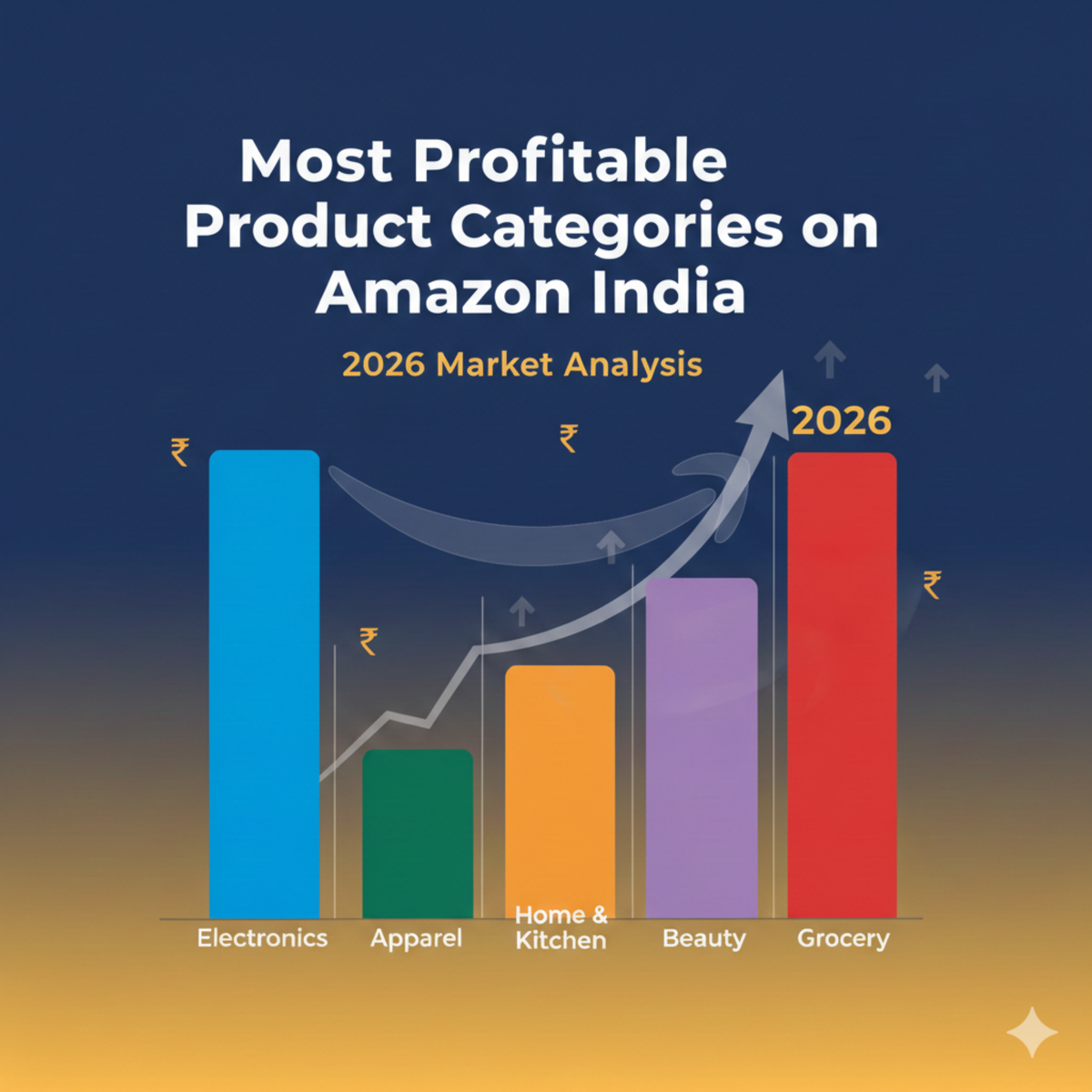
What has changed is margin pressure. Platform fees, fulfillment costs, rising ad spend, and return behavior now matter as much as demand. In 2026, sustainable success on Amazon India depends less on selling volume and more on choosing categories that preserve profitability. This analysis focuses on where margins actually hold up, using market size data, category-level profit ranges, and buyer behavior patterns.
Understanding Profitability vs. Sales Volume
High demand does not automatically lead to high profit. Most Amazon sellers discover this the hard way.
Across categories, a 15–30% net profit margin is generally considered healthy, with 20% or higher providing enough buffer to reinvest and absorb volatility. In reality, many sellers operate closer to 15–20%, especially in competitive categories where advertising and returns quietly erode margins.
Research summarized in SellerApp’s breakdown of Amazon seller profit margins shows a consistent pattern. Categories such as electronics accessories (30–50%), beauty and personal care (20–40%), and pet supplies (40–60% in premium segments) tend to outperform high-revenue but structurally thin categories like smartphones or large appliances.
Most experienced sellers rely on a simple but unforgiving formula:
Net Profit Margin = (Total Revenue − Total Expenses) ÷ Total Revenue
Those expenses typically include product cost, Amazon referral fees (usually 5–20% depending on category), fulfillment or shipping, storage, advertising (often 10–20% of sales), and GST. Sellers who chase revenue without modeling these costs usually discover that scale magnifies losses just as efficiently as it magnifies profits.
Top Profitable Product Categories on Amazon India
Beauty and Personal Care
India’s beauty and personal care market is projected to reach USD 30 billion by 2027, growing at roughly 10% annually, based on insights from the Indian Brand Equity Foundation’s consumer goods and retail coverage. While India represents only about 5% of the global beauty industry, it remains one of the fastest-growing major markets.
Margins vary widely inside the category. Industry data shows that standard cosmetics typically sit at 10–15%, while skincare products often reach 20–40%, and premium or luxury beauty brands can exceed 50%, as outlined in industry analysis of skincare profit margins in India.
Product mix matters. According to Statista’s analysis of Amazon’s beauty and personal care category, skincare accounts for roughly 32% of top-performing beauty products, followed by hair care and men’s grooming.
This category works because it combines low production costs, repeat purchasing, lightweight fulfillment, and growing demand for organic and dermatology-aligned products.
Electronics Accessories
Electronics remain one of Amazon India’s most active categories, driven by widespread smartphone adoption. Market research shows that smartphone penetration in India is approaching 80% of the population, equivalent to roughly 1.18 billion users by 2026, supported by nationwide 5G rollout and digital infrastructure growth, as detailed in Wright Research’s analysis of India’s e-commerce growth drivers.
Core electronics such as smartphones and laptops usually operate on thin margins of 8–15%. Accessories tell a different story. Margin modeling referenced in Amazon profit calculation frameworks used by electronics sellers shows that items like power banks, charging cables, and phone cases frequently achieve 40–60% margins, with most accessory ranges averaging 30–50%.
High markups, frequent replacement cycles, low return rates, and lightweight shipping make accessories structurally more profitable than devices themselves.
Fashion and Apparel
Fashion represents roughly 27% of India’s e-commerce market, making it one of the largest online categories by revenue. Industry estimates suggest the online fashion market could grow from USD 16–17 billion in 2024 to USD 40–45 billion by 2028, driven by digital adoption and festival-led demand, as summarized in Shiprocket’s overview of top-selling products on Amazon India and Amazon Shipping India’s category demand analysis.
Margins depend heavily on positioning. Mass-market apparel typically delivers 15–25%, while private-label fashion accessories and customized jewelry can reach 30–60%.
Seasonality, private-label control, customization premiums, and repeat purchases for staples such as athleisure and ethnic wear support profitability when inventory and returns are managed carefully.
Home and Kitchen Appliances
Home and kitchen products continue to benefit from lifestyle shifts and sustained work-from-home adoption. Demand has been reinforced by the rise of quick commerce, which has changed expectations around convenience and delivery speed, as highlighted in Amazon Shipping India’s insights on high-demand categories.
Small kitchen appliances typically operate at 20–30% margins, while storage and organization products often reach 25–35%. Large appliances tend to fall closer to 10–15% due to logistics, installation, and higher return rates.
Products that save time, reduce energy use, or combine multiple functions consistently command price premiums.
Pet Supplies
Pet supplies have quietly become one of the strongest profit pools in e-commerce. The global pet industry is expected to reach USD 500 billion by 2030, and India continues to benefit from sustained post-pandemic adoption.
According to high-margin product research used by Amazon sellers, pet grooming tools, orthopedic beds, and premium accessories often deliver 40–60% margins, while consumables such as food and treats usually sit at 20–30%. Additional benchmarks appear in SellerApp’s analysis of Amazon product categories.
Emotional attachment, strong brand loyalty, low return rates, and subscription potential make this category unusually resilient.
Grocery and Gourmet Foods
Amazon India’s grocery segment continues to expand rapidly, with 75%+ year-on-year growth potential, especially in specialty and premium niches. Sales frequently double during festive periods, while quick commerce now accounts for a majority of online grocery orders, as outlined in Shiprocket’s research on fast-growing Amazon categories.
Specialty coffee, organic teas, gourmet spices, and health-focused snacks often achieve 25–40% margins, supported by premium positioning and repeat purchase behavior.
Health and Fitness
Health and fitness demand has remained resilient beyond the pandemic, supported by long-term lifestyle changes. Market research from Mordor Intelligence’s India D2C e-commerce report identifies wellness and personal care as among the fastest-growing digital segments.
Fitness accessories commonly deliver 30–45% margins, supplements reach 35–50%, and yoga equipment averages 25–35%, benefiting from lightweight shipping and consistent cross-sell opportunities.
Conclusion
By 2026, profitability on Amazon India is determined less by how much you sell and more by what you choose to sell. Categories such as Beauty and Personal Care, Electronics Accessories, Pet Supplies, Specialty Grocery, and Health and Fitness offer the strongest margin potential when paired with disciplined sourcing and cost control. Sellers who focus on high-margin, lightweight products, target margins above 20%, and align with long-term consumer behavior trends are far better positioned to build durable businesses in India’s evolving e-commerce landscape.