India Post Payments Bank (IPPB) 2026: Accounts, Services & Interest
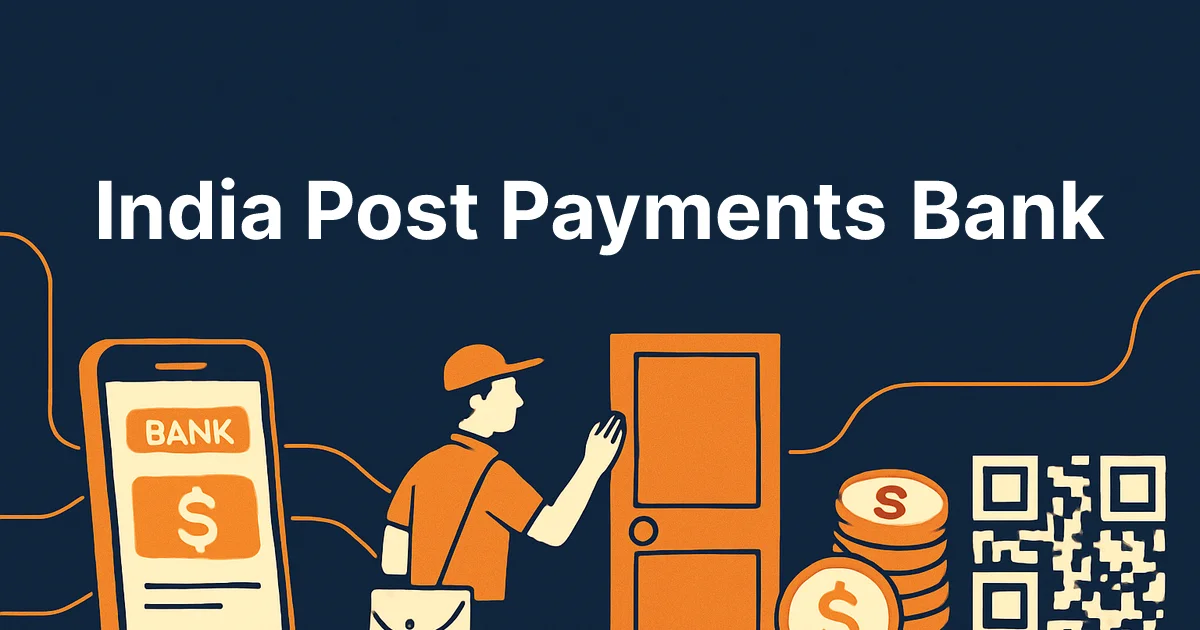
India Post quietly became one of the country's largest banks the day it launched its payments-bank arm. India Post Payments Bank (IPPB) puts a bank account, doorstep cash service and digital payments within reach of a village that may be hours from the nearest commercial branch.
Built on the postal network of roughly 1.65 lakh offices and an army of postmen, IPPB is designed for reach rather than frills. It carries no minimum balance, can be opened on a phone, and brings the postman to the door for cash deposits and withdrawals.
This guide explains IPPB in 2026 - the account types, the interest rate, the charges, the doorstep and digital services, the security to watch, and how it links to a Post Office Savings Account.
What is India Post Payments Bank?
IPPB is the payments bank run by the Department of Posts, offering savings accounts, payments and remittances rather than loans. As a payments bank, it can hold deposits up to a regulated limit and provide banking access through every post office and the doorstep service of postmen.
Its core purpose is financial inclusion: bringing basic banking to people the formal system has not reached. That mission shapes everything about it - the zero minimum balance, the Aadhaar-based account opening, and the doorstep model that turns a postman into a mobile bank counter.
How IPPB is built on the postal network
IPPB's reach comes from riding India Post's existing network of around 1.65 lakh post offices and the postmen and Gramin Dak Sevaks who already visit nearly every address. Rather than build branches, it turned that delivery network into a banking channel, which is how it reaches villages no commercial bank serves.
This is the single fact that defines IPPB: its strength is distribution, not products. A postman who already walks a village round can open accounts, take deposits and pay out cash, extending banking to the last mile at almost no extra infrastructure.
IPPB savings account types in 2026
IPPB offers five savings-account types, each suited to a different kind of customer, from a basic inclusion account to a premium variant with added services. All can be opened with no minimum balance and a nominal opening process.
| Account type | Best for |
|---|---|
| Regular Savings Account | Full-service account opened at a branch or doorstep |
| Digital (DigiSmart) Savings Account | Instant, paperless opening via the IPPB app |
| Basic Savings Account (BSBDA) | Inclusion account with limited free withdrawals |
| Premium (Premium Khaata) | Value-added services, with an opening and renewal fee |
The Digital Savings Account can be opened instantly through the app and funded by UPI, IMPS or NEFT, with a cumulative yearly deposit cap of two lakh rupees. The Regular account, opened at a branch or by doorstep, has no such cap and offers the full range of services.
"The IPPB Digi-Smart Savings Account can be opened instantly through the mobile app with a paperless process, with a maximum yearly cumulative deposit of Rs. 2,00,000." (India Post Payments Bank, DigiSmart Savings Account.)
The account types in detail
The Regular Savings Account is the full-service option, opened with biometric KYC at a branch or doorstep and carrying no deposit cap, suited to anyone wanting the complete range of services. The Digital account is the instant, app-opened version with the two lakh yearly cap, meant as a fast on-ramp that can later be upgraded to Regular.
The Basic Savings Account is a financial-inclusion account with a limited number of free withdrawals, aimed at first-time and low-frequency users, while the Premium account adds value-added services for a fee. Choosing among them comes down to how much the customer will use the account and whether they want the extras the Premium tier bundles.
IPPB interest rate and minimum balance
IPPB savings accounts pay around 2.0% per annum on balances up to one lakh rupees and 2.25% on balances above that up to two lakh, calculated on the daily balance and paid quarterly. There is no minimum balance requirement on the savings account.
This rate is separate from, and lower than, the 4% paid on a traditional Post Office Savings Account, which is a different product covered in IndiaPost's guide to the Post Office Savings Account. IPPB's appeal is access and convenience rather than the highest interest.
"IPPB savings accounts require no minimum balance and provide interest of 2.00% per annum on balances up to Rs 1 lakh and 2.25% per annum on balances above Rs 1 lakh up to Rs 2 lakh." (India Post Payments Bank, Rates and Charges.)
Charges and fees
In keeping with its inclusion purpose, IPPB keeps charges low: the savings account has no minimum-balance penalty, and many digital transactions are free or low-cost. The Premium account carries an opening and renewal fee for its added services, and doorstep service may attract a small charge per visit.
Because fees are revised from time to time, the current schedule is best confirmed on the official IPPB rates-and-charges page. For most users, the everyday cost of holding and operating an IPPB account is minimal, which is part of its appeal.
What a payments bank can and cannot do
As a payments bank, IPPB can take deposits, offer savings accounts, and provide payments, remittances and government-benefit services, but it cannot lend or issue credit cards. Its deposits are also capped at a regulated per-account limit, currently a few lakh rupees, above which funds are typically swept into a linked account.
This is the key difference from a full commercial bank: IPPB is built for saving, receiving and paying, not borrowing. A customer who needs a loan would use a commercial bank for that, while keeping IPPB for its access and everyday convenience.
Doorstep banking: the postman as a bank
IPPB's signature feature is doorstep banking, where a postman or Gramin Dak Sevak brings basic services to the customer's home. Cash deposits, withdrawals, account opening and bill payments can all be done at the door, a service that matters most in rural and elderly households.
This model uses the existing postal delivery network, so it reaches places no bank branch does. The doorstep service is the practical heart of IPPB's inclusion mission, turning the daily mail round into a banking channel.
Key IPPB services
Beyond the savings account, IPPB provides a broad set of payment and government services through its app and outlets. The most used services span everyday money movement and benefit transfers.
| Service | What it does |
|---|---|
| AePS | Aadhaar-enabled cash withdrawal and balance check |
| DBT | Receiving direct government benefit transfers |
| Fund transfers | UPI, IMPS, NEFT and QR-based payments |
| Bill payments & recharges | Utility bills, mobile and DTH recharges |
| POSA linkage | Linking and operating a Post Office Savings Account |
The Aadhaar-enabled Payment System (AePS) lets anyone withdraw cash using only an Aadhaar number and fingerprint, even without an IPPB account of their own. Direct Benefit Transfer support makes IPPB a common channel for pensions and scheme payouts.
AePS and DBT explained
AePS, the Aadhaar-enabled Payment System, lets a person withdraw cash, check a balance or transfer money using only their Aadhaar number and a fingerprint, with the postman's micro-ATM acting as the counter. This is transformative in areas with no ATM, since a villager can draw their money at the door without a card or a branch.
Direct Benefit Transfer (DBT) is the government's channel for paying pensions, subsidies and scheme benefits straight into a citizen's Aadhaar-linked account, and IPPB is widely used to receive these. Together, AePS and DBT make IPPB a practical way for benefits to reach and be withdrawn by people far from the banking mainstream.
Security and fraud awareness
Because IPPB is operated with an Aadhaar, an OTP and an MPIN, keeping these private is the core of staying safe, and the bank never asks for them over a call or message. A request to share an OTP, MPIN or Aadhaar OTP to "verify" or "unblock" an account is always a scam.
For AePS especially, users should be alert that a fingerprint can authorise a withdrawal, so biometric details and Aadhaar numbers should be shared only at trusted points. Using the official IPPB app and refusing any unsolicited request for credentials prevents the most common fraud.
How IPPB links to the Post Office Savings Account
IPPB integrates with the traditional Post Office Savings Account (POSA), letting a customer link the two and move money between them. This bridges the older counter-based savings system with app-based banking.
For a saver who holds a POSA and the small-savings schemes, IPPB acts as the digital front end - paying in, checking balances and transferring funds without a branch visit. Opening the account is a quick, app-based process, set out in IndiaPost's guide to how to open an IPPB account online.
IPPB versus a Post Office Savings Account
The two are different products that work well together. A Post Office Savings Account pays the higher 4% interest and is the gateway to small-savings schemes, while IPPB pays a lower rate but adds doorstep service, UPI, AePS and instant app opening.
| Feature | IPPB | Post Office Savings Account |
|---|---|---|
| Interest | ~2.0 to 2.25% | 4.0% |
| Opening | Instant via app or doorstep | At the post office counter |
| Digital payments (UPI, AePS) | Yes | Via linkage to IPPB |
| Deposit cap | Regulated payments-bank limit | No such cap |
The common pattern is to hold both: the POSA for the higher interest and scheme access, and IPPB for the digital and doorstep convenience, linked so money flows between them. Each plays to its strength rather than replacing the other.
Who IPPB is for
IPPB suits anyone who values easy access and everyday payments over the highest interest, and especially those in rural or underserved areas where the postman is the nearest banking point. First-time account holders, pensioners receiving DBT, and households wanting doorstep cash service are its natural users.
For a saver focused purely on returns, the higher-interest POSA or a small-savings scheme is the better home for the bulk of their money. IPPB earns its place as the convenient, accessible account for receiving, paying and withdrawing, often alongside those higher-yield products.
The scale and significance of IPPB
Since its launch, IPPB has grown into one of the most far-reaching banking platforms in the country, precisely because it sits on top of the post office network rather than competing with it. The combination of a vast physical footprint and a mobile app gives it a reach few banks can match.
For the wider goal of financial inclusion, this scale is the point: every post office and postman becomes a banking access point, so a person far from any branch is rarely far from IPPB. That breadth, more than any single feature, is what makes the payments bank significant.
Methodology
Account types, interest rates, balance rules and services are drawn from the official India Post Payments Bank website, including its rates-and-charges and account pages, as of the time of writing. IPPB rates, fees and product features can change; customers should confirm the current details on the official IPPB site before opening an account.
Key takeaways
- IPPB is the Department of Posts' payments bank, built for reach through 1.65 lakh post offices and doorstep service.
- It offers Regular, Digital (DigiSmart), Basic and Premium savings accounts with no minimum balance.
- Interest is about 2.0% up to one lakh and 2.25% above, separate from the 4% Post Office Savings Account.
- As a payments bank it takes deposits and offers payments, but cannot lend or issue credit cards.
- Doorstep banking brings cash deposit, withdrawal and account opening to the customer's home.
- Services include AePS, DBT, UPI/IMPS/NEFT transfers, QR payments, bills and recharges.
- IPPB links to the Post Office Savings Account, acting as its digital front end.
Looking ahead
IPPB keeps widening its digital and doorstep services, steadily turning the post office into a full banking touchpoint for households the formal system once skipped. For 2026, its value is clear: not the highest interest, but the easiest access - a bank account that can be opened on a phone and operated at the front door.